
AI and DEI: Automated insights for inclusive storytelling
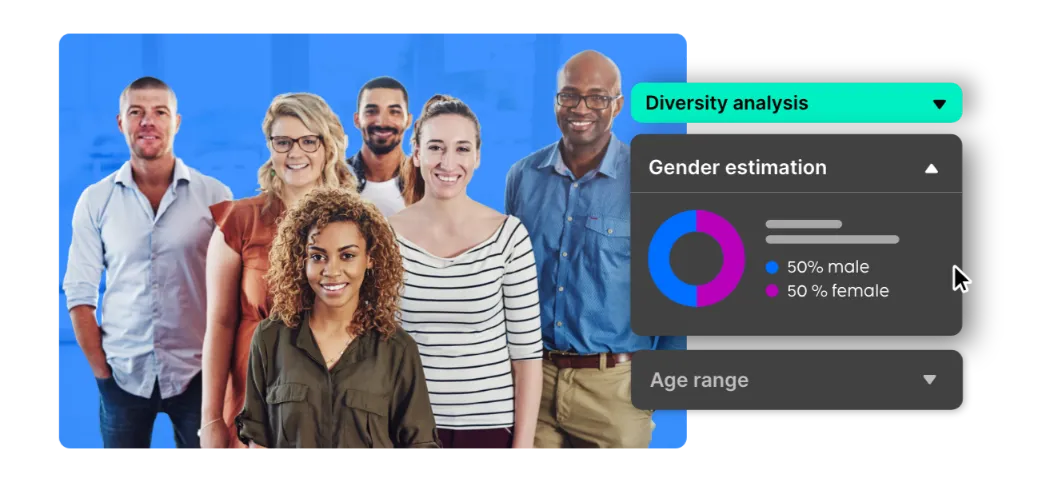
Our Diversity Analysis AI model helps media producers, broadcasters, and cultural institutions put diversity, equity and inclusion (DEI) into action — by automatically tracking gender and age representation in images and video.
Shaping Inclusive Media Starts Here
Smarter tools for more inclusive stories
Why it matters—and what you’ll gain
Automated DEI insights, minus the manual work
Track gender and age diversity in real-time across any media asset. No spreadsheets. No manual tagging.
Support for ESG, funding & public trust
Use clean, structured diversity data to meet reporting requirements, qualify for funding, or communicate your commitment to inclusion.
Plug-and-Play for media workflows
It fits into your current stack—media asset management systems, editorial tools, even legacy archives.
Time-synced video analytics
Our tool breaks down demographic presence by timestamp, so you see not just who’s included—but when and how often.
Diversity Analysis module is part of our Deep Media Analyzer application. Check it out now:
What you’ll get
We’re not just throwing numbers at you. Here’s what the Diversity Analysis delivers:

Comprehensive gender and age insights
Instantly access clear, visual breakdowns of gender and age representation.

Timeline-based segmentation
The module visually maps out gender dominance and neutrality throughout the video, allowing you to see at a glance which segments feature female, male, or gender-neutral representation.

Privacy-first design
Ethnicity or skin tone? Not included — by design. The model respects individual dignity and adheres to all data protection standards like GDPR.
Practical Applications
Where it works—and how you can use it
Diversity and inclusion in media isn’t just a checkbox—it’s a strategy. Here’s how media teams are using our tool.
frequently asked questions
Have a question? We’ve got answers
What kind of attributes does the model detect?
Why doesn’t the Diversity Analysis model detect ethnic diversity?
1. Ethnicity is a socially constructed and contextual concept Unlike age or gender, ethnicity cannot be inferred objectively or consistently from visual features alone. Definitions of ethnicity vary widely across cultures, regions and institutions, making it technically unreliable and ethically problematic to train a generalizable model for it.
2. High risk of bias and harm Even advanced AI systems can reinforce stereotypes or show bias when trained to classify ethnicity, especially if the training data is not perfectly balanced — which is almost impossible on a global scale. Misclassification can lead to discrimination, marginalization or the misuse of sensitive data.
3. Privacy and regulatory compliance Ethnicity detection can quickly enter the realm of sensitive personal data, which is subject to strict regulations under laws such as GDPR and the EU AI Act. To ensure compliance and avoid ethical grey areas, we deliberately exclude this feature from the model.
Is your service GDPR compliant?
Yes, DeepVA is fully GDPR compliant. We take data protection and privacy seriously and ensure that all personal data is processed in accordance with GDPR regulations.
How is my data handled? Does the AI learn from my data?
You have full control over your data on our AI platform, ensuring it remains secure and compliant. By default, we do not use your data to train our models, keeping it proprietary. However, you have the option to train models using your data, and in that case, it will remain exclusive to your organization.
What type of data do you store?
By default, we do not process your data beyond what is required to provide our services. If additional processing is necessary, it will only occur as outlined in your instructions or where legally required. For example, data may be transferred or processed as needed to fulfill service requirements, always in alignment with our agreements.
To learn more about how we process data and the safeguards in place, please refer to our Data Processing Agreement.